
PATTERNA · FOUNDATIONAL ARTICLE
The DARVO Family: Self-Protection and the Logic of Responsibility Distortion
Article and contextual explanations in English
Rafael Caferati
Draft 0.4 · 15 September 2026
Length: 6,584 main-text words under the counting convention recorded in the evidence ledger; references and mathematics excluded.
Editorial status: Theoretical manuscript. Definitions, propositions, proof constructions, and research implications are developed without a case study. Source verification and revision history are recorded in the evidence ledger ↓ .md.
Listen to this article
1. Abstract
DARVO-family maneuvers preserve a claimed position within the represented account by distorting represented agency, contribution, or responsibility through denial, directed blame or disqualification, and reversal. This article establishes a family framework in which PAST operates through false present closure and backward blame, while FATE operates through obscured causal contribution and manufactured vindication. Within that family, we distinguish the complete DARVO response's observable configuration from a supported finding of accountability distortion. The latter requires independently established answerability and a material misrepresentation or invalid substitution. We formalize these conditions for scoped incidents, preserve operation-specific actor links, and validate predicate dependencies before three-valued assessment. Five propositions establish the argument's inferential structure: a distinct counteraccusation does not automatically negate the original responsibility; configuration alone does not determine substantive distortion; audience rejection does not negate an established mechanism; later enactment does not itself establish earlier anticipated reliance; and reduced expected accountability increases modeled utility under stated assumptions, with a changed maximizing choice requiring additional conditions. We specify how established premises entail a complete-response finding and how distinct incident witnesses establish recurrence. Shared family operations remain distinct from the co-occurrence of complete mechanisms in one incident. The account separates functional self-protection from knowledge, intention, and effects. Its contribution is a theoretical specification connecting responsibility, representation, and evidence through explicit definitions and proofs.
Keywords: DARVO; accountability; responsibility; interpersonal abuse; agency; evidence; PAST; FATE.
2. The question that remains
A counteraccusation introduces a second responsibility question. It does not, by its introduction, answer the first. When an actor's conduct is under examination, a response can direct attention toward the character, intentions, or conduct of the person seeking accountability. The response changes what the audience is asked to judge. The original conduct remains a separate object of judgment, together with the grounds on which its responsibility rests.
The second grievance can be genuine. That fact makes the relationship between the two questions more important. Each concerns particular conduct, circumstances, and grounds of responsibility. Establishing one does not automatically settle the other. An accurate observation about the counterpart can be placed inside an inaccurate account of what the operator owes, controls, or has caused. Truth in one part of the response does not validate the substitution made with it.
This is the accountability problem examined here. A response can reorganize the represented situation so that the person whose conduct is under examination appears entitled to protection from the examination itself. The response makes the counterpart's character or intentions the apparent question to be answered. The account has changed the apparent object of responsibility: answering for the original conduct gives way to answering for having raised it. Where the record establishes that this substitution materially distorts responsibility, the distortion can be identified directly.
Freyd introduced DARVO to describe connected denial, attack, and reversal of victim and offender in responses to accountability. Her original discussion locates the reversal in the representation of the abuser as wronged and the person seeking accountability as offending; it also distinguishes denial from evidence of guilt (Freyd, 1997, pp. 29–30). These distinctions make the underlying conduct indispensable to analysis. The represented roles must be examined against the responsibility they purport to explain.
We develop that inquiry at two levels. First, we define the DARVO family as self-protective maneuvers that distort represented agency, contribution, or responsibility through denial, directed blame or disqualification, and reversal. PAST and FATE are members of this family. Second, we specify the complete DARVO response as a particular linked configuration and distinguish its observable form from a supported finding of responsibility distortion. This distinction preserves the force of an established finding while making its premises inspectable.
The formal argument has a practical object. It keeps the original responsibility present as the conversation introduces new material. It separates a meaningful defense from an invalid cancellation, an available choice from asserted impossibility, and an outcome from the explanation imposed on it. It also separates what the maneuver does to the account from what its audience eventually believes. A misleading account can be rejected and remain a misleading account.
The article contributes a family organization, an explicit complete-response specification, and five propositions governing the conclusions that follow. The propositions establish non-cancellation, the distinction between form and substantive support, persuasion invariance, the insufficiency of later enactment to establish prior reliance, and a conditional expected-accountability result. Each has a stated scope. The resulting certainty attaches to a demonstrated relationship among established premises. It does not depend on making every question about the participants equally certain.
The argument proceeds from definitions to derivations. Section 7 specifies how incident findings, concurrent responsibilities, intersecting mechanisms, and recurrence follow from their respective premises. Section 8 identifies the empirical questions that this formal separation makes available for investigation.
3. The self-protective family
3.1 Definition and hierarchy
The family's canonical definition is:
The DARVO family comprises self-protective maneuvers that distort the representation of agency, contribution, or responsibility through denial, blame or disqualification directed at the counterpart, and reversal of the represented responsibility structure. PAST and FATE are members of this family: PAST operates through false present closure and backward blame; FATE operates through obscured contribution and manufactured vindication.
This definition organizes the mechanisms by the work performed on an account (Patterna, 2026a). Denial removes or discounts a material feature of the situation. Directed blame or disqualification assigns the counterpart a reason to be faulted or disregarded. Reversal reorganizes represented responsibility so that the operator's position appears vindicated, compelled, or injured. These are connected operations. An ordinary omission, a relevant criticism, or a changed description does not establish the family mechanism merely by resembling one of them.
Fix an evidence record, incident scopes, and definition versions. Let be the common universe of scoped incidents. Let , , and contain incidents supporting PAST, FATE, and the supported complete DARVO response respectively; let contain DARVO-family incidents. All four are subsets of . The organizing rule is:
PAST and FATE are DARVO-family maneuvers under this definition. The inclusion supplies their conceptual placement; the incident evidence supplies their classification. The family need not be exhausted by these members. An intersection concerns two mechanisms established in the same incident, rather than two unrelated events involving the same people. Membership alone supplies none of the missing predicates of the complete response.
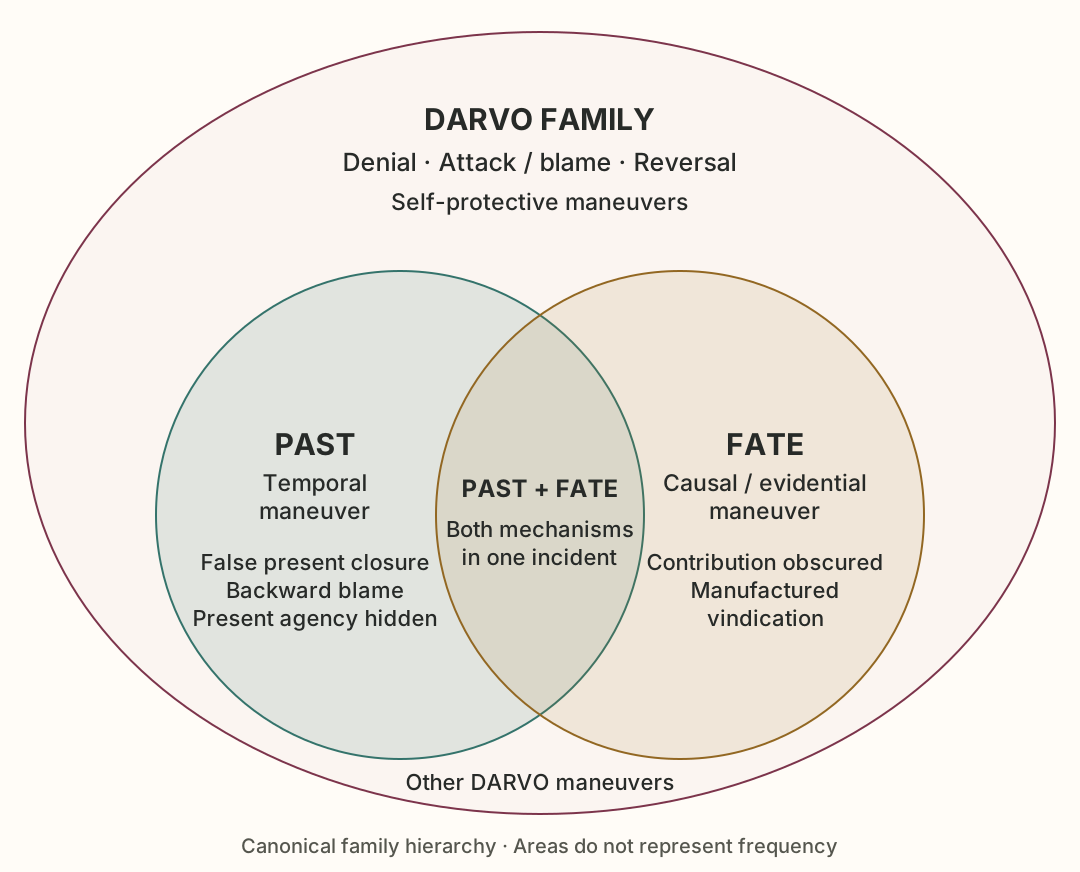
Figure 1. Canonical family relationships. Areas express conceptual membership and overlap, not frequency. The complete response is not confined to the area outside PAST and FATE.
3.2 Shared operations, distinct mechanisms
| Operation | Complete DARVO response | PAST | FATE |
|---|---|---|---|
| Denial | Wrongdoing or answerability is rejected. | A meaningful present option and associated agency are suppressed. | Material contribution is obscured or unjustifiably discounted. |
| Attack or blame | The counterpart or accountability claim is disqualified. | Their past conduct is presented as the cause of an asserted present impossibility. | They receive misleading blame reinforced by the outcome. |
| Reversal | Operator represented as harmed; counterpart as offending. | Operator represented as constrained; counterpart as responsible for the impasse. | Contributor represented as vindicated; harmed counterpart receives responsibility. |
Table 1. Shared operations and their different objects.
The complete response requires the paired representation of operator as harmed and counterpart as offending. Family reversal is broader: it concerns the represented structure of responsibility. An operator appearing unable to act is not necessarily claiming to be a victim. An operator claiming predictive vindication is not necessarily making every role claim required by the complete response. The shared family relationship preserves these differences.
Chronology can remain factually accurate throughout a distorted account. The counterpart may indeed have asked later than preferred. The predicted outcome may indeed have occurred. What requires examination is the relationship assigned to those facts. A past delay does not erase a present remedy that remains available. A correct forecast does not remove the forecaster's contribution to its realization. Responsibility can be distorted without reversing the dates.
PAST is the temporal maneuver. It represents an available present course as closed and assigns that closure to the counterpart's past conduct, suppressing present agency without meaningful engagement with the remedy. The relevant decision point matters: later acknowledgment of choice does not erase an established earlier suppression (Patterna, 2026c). FATE is the causal and evidential maneuver. The operator materially contributes to a specified adverse outcome, misleadingly assigns responsibility to the counterpart, and reuses the outcome to vindicate that misleading account. Confirmation of predictive accuracy alone does not complete FATE (Patterna, 2026d).
Each mechanism has a concise logical anchor. For PAST, fix objective , constraint set , decision time , and candidate-remedy domain . Let mean that remedy is meaningfully and practically feasible within that scope. Then:
An evidenced witness contradicts universal remedy absence. A remedy serving another objective or replacing a different, narrowly specified procedure does not refute the original claim. Feasibility also remains distinct from permission and obligation. This contradiction supplies the logical anchor; a complete PAST finding additionally establishes its other linked conditions.
For FATE, let mean that operator forecast outcome before realization, that it occurred, and that the accompanying account assigning responsibility to counterpart is correct. Then:
Two constructed models establish the non-entailment. In one, the counterpart authors the specified harm and the operator correctly attributes it. In the other, the operator authors the same kind of harm and falsely attributes it to the counterpart. The forecast and realized outcome are present in both; the responsibility account differs. The construction stipulates the authorship and relevant responsibility grounds. It is a proof model, not a reported conversation.
Causal models make the contribution question explicit by representing how variables determine an outcome and what changes under intervention (Halpern & Pearl, 2005). Causal contribution and responsibility allocation still require their respective grounds. FATE's full specification addresses these relationships; forecast accuracy cannot stand in for them.
3.3 What self-protection means
Self-protection names a representational function: preserving a claimed position through a distorted account. That position can concern innocence, reasonableness, judgment, control, a preferred outcome, or freedom from accountability. The family definition identifies the functional orientation. A case-specific explanation identifies the particular position and the evidence connecting the maneuver to its preservation.
Function, knowledge, intention, and outcome therefore remain separately assessable. The account can obscure agency before the record establishes whether its author consciously recognized that obscurity. A deliberately misleading response can fail to persuade. An original mistake can precede a self-protective maneuver. Neither selfishness nor whim is required as the original cause. The analysis follows the conduct and the account actually established, without supplying a psychological biography to complete the definition.
4. Scholarly origin and conceptual distinctions
4.1 From the response concept to its study
Freyd's original formulation identifies the connected response and its accountability context. The broader family hierarchy developed here is Patterna's organizing definition. It retains that attribution while extending the analysis to temporal agency suppression and causal–evidential vindication. The empirical literature must be read according to the response concepts and measures its studies actually use.
Harsey et al. (2017) examined reports from 138 undergraduates about confronting someone over wrongdoing. Their reported findings connect the DARVO components with one another and greater exposure with greater self-blame. This provides evidence about reported confrontation experiences. It does not, by itself, establish the truth of every original accusation or an operator's prior expectation of protection. Those are separate questions for the incident record.
Experiments provide a different kind of evidence. In the first experiment by Harsey and Freyd (2020), DARVO reduced victim believability and increased victim responsibility and abusiveness judgments. It also reduced perpetrator responsibility and abusiveness judgments, while reducing perpetrator believability. The comparison response admitted responsibility and expressed remorse. Their second experiment held the DARVO-containing sexual-assault statements fixed and varied whether participants received information explaining DARVO.
Harsey and Freyd (2023) studied DARVO crossed with an insincere-apology manipulation in a professor–student sexual-abuse vignette. Perpetrator believability increased under DARVO; perpetrator responsibility and abusiveness decreased, while victim believability decreased and abusiveness increased. Victim responsibility did not differ significantly. Here, comparison responses included silence or a nonadmitting apology. The opposite believability directions were observed under different experimental comparisons. These studies do not isolate what caused the difference. The source-version and denominator distinctions are recorded in the evidence ledger.
These findings make the object of an effect claim important. Reduced responsibility, increased believability, and successful persuasion are not interchangeable outcomes. A response can alter one judgment without moving another in the same direction. An episode assessment should likewise identify the particular audience, judgment, and observation window rather than compress them into a single claim that DARVO “worked.” The formal classification developed below does not require that effect claim.
Harsey et al. (2024) found associations between total reported DARVO use, rape-myth acceptance, and sexual-harassment perpetration in undergraduate and community samples. The authors explicitly identify the design as correlational and leave directionality unresolved. The result supports a measured relationship among those variables. It does not turn their association into evidence that anticipated DARVO protection caused a particular conduct decision.
Durland et al. (2026) developed an 18-item short form and examined associations with trauma symptoms. Its items comprise denial, attack, and role-reversal statements. That instrument measures reported exposure. Our predicate specification asks whether a particular linked response and its substantive distortion are established in a scoped record. These are different analytical outputs: a questionnaire score is not an automatic episode certificate, and an episode certificate is not a symptom measure.
4.2 Responsibility, contribution, and the account
Responsibility analysis requires more than locating an unpleasant sentence. Malle et al. (2014) distinguish causal involvement, intentionality, reasons, obligation, and capacity within their theory of blame. Those distinctions help articulate why identifying an outcome, a negative emotion, or a participant's role does not settle every responsibility question. The present framework evaluates the particular grounds of answerability and the response's treatment of them.
A relevant challenge to an account can improve the inquiry. Evidence that a claim was fabricated, that a commitment had already been discharged, or that a constraint genuinely prevented action belongs in the assessment. Equally, a personal criticism can be accurate and deployed irrelevantly. If the question concerns an unfulfilled commitment, an established flaw in the claimant's character does not itself explain why that commitment ceased to bind. What matters is the inferential connection offered between the facts.
There are important antecedents to the operations grouped here. Sykes and Matza (1957) describe neutralizations that precede conduct, the transformation of a victim into a wrongdoer, and attention redirected toward those condemning the act. Bandura (1999) describes responsibility displacement and blame attribution that represents harmful conduct as compelled by another person's provocation. These accounts establish a conceptual history for anticipatory justification, directed attack, and reversed responsibility. The present contribution specifies their relationships within the DARVO family and makes incident-level evidentiary requirements explicit.
FATE also has a direct antecedent in Merton's (1948) treatment of self-fulfillment and subsequent apparent vindication. The outcome helps make the original account appear correct after conduct has helped produce that outcome. FATE specifies the contribution, misleading attribution, episode linkage, and evidential reuse that establish its particular maneuver. Naming those conditions clarifies what an analyst must demonstrate.
4.3 Context and inferential authority
Grice's (1975) distinction between what is said and what is implicated directs attention to meaning within an exchange, including reference and the circumstances of utterance. That distinction is useful when an operation is conveyed without an explicit declaration of its purpose. It does not make every plausible implication conclusive. The analyst must establish the particular contextual inference on which the finding depends.
The literature and the formal analysis thus have complementary jobs. Studies establish measured relationships under their designs. Conceptual antecedents identify explanatory distinctions. The formal specification states the conditions under which a finding follows. A source can ground one of these tasks without supplying the others. The certainty of a demonstrated non-entailment survives uncertainty about the prevalence of a maneuver or the magnitude of its psychological effects.
5. A formal framework for the complete response
5.1 Incident, responsibility, and evidence
The unit of analysis is a scoped accountability incident . It binds particular actors, conduct, an accountability issue, and the response addressing that issue. It may span several messages or source segments. Its boundary follows the substantive relation, not the size of a display window. A complete export can contain several incidents; two exports can preserve the same incident.
Let be the operator whose conduct is under examination, the principal counterpart, and an audience. Let be a specified decision about conduct, an action, a relevant time, and the review cutoff. Fix evidence record and definition bundle . Role assignments are local to the incident. They are not permanent moral identities assigned to participants.
Responsibility also requires a specified object. Write for actor 's particular responsibility for conduct in incident . An obligation record may be represented as : an obligation concerning , owed to , on basis , under conditions , with deadline . A request, commitment, preference, and applicable obligation are distinguishable. The original responsibility must be established on its own grounds before an account can be shown to distort it.
This specificity preserves asymmetry without assuming it. One participant can be responsible for creating a harmful condition and another for a disproportionate response. Both findings can be retained. The second does not eliminate the first, and a difference in tone does not determine their relative causal or normative significance. Assessment follows the conduct, its conditions, and the burden it imposes.
5.2 From attributed statements to established premises
Let mean that actor communicates proposition at time . Communication alone supplies no general rule taking an attributed proposition to its truth. There are admissible choices of for which:
A constructed model in which a speaker falsely states that a deadline has passed supplies a witness: the communication occurs and its content is false. The failure of a general rule leaves particular truth-establishing communicative acts to be assessed on their own terms.
A statement's occurrence is distinct from the truth of its content. Yet a conversation can establish the premises needed for its own analysis. A recorded commitment can establish that it was undertaken. An authored insult can constitute the very conduct being examined. A sequence of statements, actions expressed through messages, and source-supported circumstances can establish a contradiction without an external confession explaining that contradiction.
Three connected records make the inference inspectable. The source record preserves attributed messages and context. The premise record states what those sources establish, with the reasoning and any counterevidence. The conclusion record identifies the rule applied to those premises. A label is the result of that sequence; it cannot serve as the premise that validates its own application.
Fix the predicate meanings, incident bindings, and background rules, including the stated grounds of responsibility, independently of the conclusion being tested. Let contain every interpretation satisfying those commitments and the explicit premise set . Require consistency and at least one such interpretation:
Logical closure is the persistence of the conclusion across all those interpretations. An interpretation satisfying the fixed premises and rules cannot be excluded merely because it falsifies the proposed conclusion; it is a countermodel that defeats the claimed entailment. A short exchange is complete for a particular claim when it establishes every premise that claim requires, even while other questions remain open. Neither length nor repetition is a universal prerequisite for closure. Conclusive contextual evidence has the same logical standing as conclusive explicit evidence once its premises and inference are established.
Conflicting utterances do not require accepting contradictory world facts. The record can consistently establish that someone asserted and later asserted . Establishing their substantive incompatibility requires the same referent, time, objective, and circumstances. If those changed, the apparent contradiction may dissolve. If they did not and the relevant facts are established, the contradiction stands. An alternative interpretation that simply discards an established premise is a challenge to that premise, not a countermodel satisfying it.
5.3 Observable configuration and substantive support
We use complete-response configuration for the linked observable form and supported complete DARVO response for that form together with established answerability and material distortion. The predicates below share the same incident bindings and follow the corrected complete-response specification (Patterna, 2026b).
| Predicate | Required condition |
|---|---|
| A specified accountability issue is present or expressly anticipated. | |
| The response denies wrongdoing or responsibility. | |
| An attack on the principal counterpart or an evidence-linked supporter is deployed to discount the counterpart or accountability claim. | |
| The operator is represented as harmed. | |
| The principal counterpart is represented as offending. | |
| The candidate operations and role assignments are substantively linked to the same established accountability issue. | |
| The operator's relevant harmful conduct or specified answerability is supported independently of the label. | |
| The account materially misrepresents that responsibility or makes an evidenced invalid substitution that discounts, transfers, or avoids it. |
The structural and substantive classifiers are:
The paired role representation is . These predicates concern represented roles; they do not presuppose that those representations are accurate. Nor must the operations occur in acronym order. Linkage connects them to the same issue even when denial, attack, and reversal alternate across the exchange.
An attack can target a supporter rather than the principal counterpart. In that case, the record must identify the actual target, the supporter's relation to the counterpart's claim, and the use of the attack to discount that claim. The principal counterpart represented under does not silently become the supporter. Each positive requires a supported target-link witness with the correct actors and issue. A target's involvement alone supplies neither a disqualifying attack nor the truth of the original allegation.
The substantive conditions prevent surface resemblance from deciding the finding. A true countergrievance does not automatically make false: its use may still involve an invalid cancellation. Conversely, missing corroboration of an allegation does not make true. The material discrepancy must be established. Independence from the label means that the evidence supports the particular responsibility without circularly appealing to the classification.
5.4 Evidence states and dependent annotations
Evidence assessments take three values: for supported, for contradicted or established absent, and for unresolved. For reviewed, semantically valid inputs, conjunction is false if any required condition is false, true if all are true, and unresolved otherwise. Negation exchanges and and preserves .
| T | U | F | |
| U | U | F | |
| F | F | F |
Here are assessed propositions. This evidence-state aggregation is distinct from classical consequence over accepted premises. The table states how a composite assessment is obtained after the premises have been reviewed. It does not discover the truth of those premises.
The order of operations matters because some annotations have dependencies. Linkage to an established accountability issue presupposes that issue: . Accordingly, with is inconsistent, while a positive with unresolved requires review. Neither should be disguised as an ordinary negative or unresolved classification. By contrast, with a qualifying attack established absent is a valid negative configuration. Linkage does not fill the operation flags.
A finding withheld for inconsistent or incomplete dependency annotations has a review status, not a fourth truth value. Once the assessments are reconciled, the affected conjunction is evaluated. Reviewed implication rules support positive and negative deductions. Under , established entails ; established entails by contraposition. The source-grounded derivation establishes the affected assessment, while an unreviewed flag cannot authorize automatic promotion. Unaffected findings remain available.
Negative findings require evidence appropriate to their scope. An unexamined passage does not establish absence. A fully reviewed exchange can establish that an operation is absent from that exchange; missing records may leave the same question unresolved. This distinction lets a negative conclusion have evidentiary force without confusing silence in the annotation with nonoccurrence in the conversation.
5.5 Particular protection, knowledge, and prior reliance
Additional findings answer questions the base conjunction does not settle. Let identify a particular protected position and its evidenced relation to preservation through the response. Let establish awareness of the particular material discrepancy assessed under , and purposeful use of the response to obstruct accountability. Then:
A particular protected interest requires more than restating that the response deflects accountability. Awareness requires evidence of recognition of the actual discrepancy, rather than mere access to facts from which an analyst can derive it. Under this definition, . Knowledge and purposeful obstruction remain separate; neither flag alone supplies the other.
For decision , let mean that, before the choice is completed, the operator expects protection through the complete DARVO response concerning the conduct considered or continued. Let mean that expectation contributes to willingness to proceed. Let establish substantive and temporal correspondence among operator, conduct, contemplated mechanism, and the later response. Define:
Influence presupposes the expectation's existence, so . A positive dependent with a false prerequisite is inconsistent; with an unresolved prerequisite it requires review. Influence need not be the sole cause, a but-for condition, or a strict switch between actions. Generic anticipated impunity is not automatically DARVO-specific expectation.
The correspondence predicate requires evidence of the relation, not merely two positive records with the same name. A properly bound pair with is a legitimate negative paired finding; standalone incident and decision findings can remain positive. Event time and documentation time also differ. A later, well-supported account can establish an earlier expectation, while a later maneuver alone does not establish that it was anticipated.
Outcome is recorded separately by protected target, audience, and observation window. A retained benefit alone does not show that the response preserved it. A rejected response does not cease to instantiate its established operations. These distinctions permit strong findings without assigning every explanatory dimension the same value.
6. Five propositions
6.1 D1 — Responsibility does not cancel by counteraccusation
Fix actors , distinct conduct , and incident scope . The responsibility predicate retains its specified meaning. Then:
Proof. Construct an interpretation in which each actor has independently breached a separate applicable commitment. Both responsibilities hold. The premise concerning is true while the proposed exoneration of is false. Thus the premise alone does not entail that exoneration. This is a constructed countermodel, not an empirical case.
A justification or discharge rule can change the analysis when supplied as an additional supported premise. For example, an obligation may have expressly depended on a condition that was not satisfied. That connection must be established rather than inferred from the mere presence of another grievance. D1 rejects automatic cancellation; it does not assert that responsibilities can never interact.
The proposition also does not establish the original responsibility from an accusation. That is the work of . Once the relevant responsibility and the invalid substitution are independently supported, a true second grievance cannot make the substitution valid by its truth alone. Each question retains its own grounds.
6.2 D2 — Configuration does not determine substantive distortion
An established does not alone entail or .
Proof. Consider a constructed model with a false original allegation, a denial of wrongdoing, an accurately grounded attack on the claimant's fabrication, and representations of the respondent as harmed and the claimant as offending. All operations concern the same allegation. The six form predicates hold, but original answerability is absent and the account accurately represents the stipulated facts: .
In a second constructed model, the operator's harmful conduct is independently established. The response denies responsibility, attacks the counterpart to discount the claim, and misleadingly represents the operator as harmed by the counterpart's pursuit of accountability. The six form predicates again hold, and now . Because the form admits both models, it does not determine substantive support. The comparison holds configuration constant, not every word or underlying fact.
The two models establish that the same configuration is compatible with an accurate defense and with a distorted account. A genuine grievance likewise supplies no automatic cancellation of the other actor's responsibility, as D1 establishes. Classification turns on the demonstrated relationship between account and responsibility. Counting familiar phrases cannot replace that examination.
6.3 D3 — Audience rejection does not negate the mechanism
Fix the relevant predicate assessments, incident scope, operation targets, evidence links, and validation status. Vary only audience acceptance.
Proof. Audience acceptance occurs in none of the complete-response conjunctions or their dependency conditions. Their inputs remain unchanged, so their values remain unchanged. A supported complete response retains its classification and its canonical family membership whether the audience accepts or rejects the account.
This invariance concerns a precisely isolated change. If a later response supplies new evidence that alters a premise, that evidence must be assessed. Rejection itself supplies no automatic negation of the already established operation. Conversely, acceptance does not establish a missing predicate.
The result distinguishes the account's distortion from its persuasive effect. Someone who correctly identifies the maneuver does not retroactively make it absent. Their rejection changes the outcome of the encounter, while leaving the established conduct answerable.
6.4 D4 — Later enactment does not establish prior reliance
A supported complete response in does not, by itself, establish prior expectation or its contribution at the earlier decision.
Proof. Construct two earlier histories ending in the same observed later response. In the first, the operator expects DARVO-specific protection before choosing the conduct, and that expectation contributes to willingness to proceed. In the second, the operator has no such expectation and produces the same response only after the conduct is challenged. Both histories satisfy the later-response premise; their prior-reliance assessments differ. Therefore the premise does not determine prior reliance.
A later deliberate response likewise does not by itself establish prior planning. It can form part of an evidentiary account, but the required earlier state and influence still need support. Contemporaneous statements, or a later account that establishes the earlier state, can provide that support. The decisive distinction is between the time of the expectation and the time of the evidence documenting it.
An unresolved anticipation finding leaves an independently supported incident intact. This matters because the complete response's abusive distortion does not wait for a full explanation of how the operator arrived at it. The event and its preparation are different objects of proof.
6.5 D5 — Reduced expected accountability cost increases modeled utility
For a feasible candidate action , let be modeled expected utility, anticipated benefit, direct cost, the perceived probability of a specified accountability event, and the conditional expected utility loss if that event occurs. Use common utility units and assume additive separability:
Let subscripts 0 and 1 identify baseline and anticipated-protection conditions. Hold benefit, direct cost, and conditional loss fixed. If and , then:
Proof. Subtract the two utility expressions. The unchanged benefit and cost terms cancel. The remaining probability difference and loss are both positive, so their product is positive. The modeled action becomes more attractive under the stated assumptions.
A changed choice requires comparison with alternatives. Suppose the actor maximizes utility over a finite feasible set containing and at least one alternative. Hold all alternatives' utilities fixed and let:
If , action moves from nonoptimal to uniquely optimal. Before the change, an alternative is better; afterward, exceeds the best alternative. This establishes the strict choice result under the specified decision rule.
The boundary cases identify exactly what the proof uses. With zero conditional loss or no probability reduction, this parameter change supplies no utility increase. An increase from 1 to 2 with an alternative at 3 does not change the maximizing action. Equality with the best alternative establishes a tie, not unique optimality. Changes in benefits, costs, available actions, or the decision rule require a correspondingly revised model.
The theorem establishes a conditional relationship. It supplies no numerical estimate of a participant's beliefs and no automatic finding that anticipated protection influenced their decision. Those are the evidentiary objects of and . A supported influence finding can also concern reinforcement of willingness without a proven strict switch. The algebra explains one way expected accountability enters a choice; the record establishes whether that relationship operated in the case.
7. Derivation, scope, and recurrence
7.1 From premises to the complete response
A complete-response finding joins judgments about conduct, representation, and their relationship. Fix incident , its operator, principal counterpart, accountability issue, response scope, evidence record, and definition version. Let be an explicit, consistent set of established premises with at least one admissible interpretation. Use the eight predicates defined in section 5.3. If entails each required predicate under these common bindings, conjunction introduction yields:
The second entailment follows by the complete-response definition. The derivation establishes precisely what the premises jointly require. Applying the conjunction does not establish its inputs: their support comes from the attributed communication, accepted contextual facts, and explicit inferences recorded in . Dependency review establishes that the annotation set is coherent before aggregation.
The evidentiary obligations differ across predicates. A role statement can establish a represented role without establishing that the speaker actually occupies it. Authorship can establish who performed a communicative action. Answerability requires the relevant grounds of responsibility. Material distortion requires the discrepancy or invalid substitution joining that responsibility to the response. An attack label alone cannot establish those grounds or supply the missing discrepancy.
Conclusive contextual inference has the same standing as conclusive explicit evidence. Its bridge must remain visible: which facts establish the object of denial, which accountability issue an attack discounts, and which responsibility the reversed account purports to explain. An explicit denial needs the same binding discipline. Neither a familiar phrase nor an analyst's classification substitutes for the relationship being established.
An unresolved premise remains unresolved in the assessment record. It cannot enter as an established fact simply because the other conditions are supported. Once all required premises are established, the conclusion follows. Questions about a particular protected interest, conscious purpose, prior expectation, or successful persuasion remain separately assessable and do not suspend that derivation.
7.2 Concurrent responsibilities and intersecting mechanisms
The unit of judgment is a scoped relationship between conduct and responsibility. Proposition D1 permits established responsibility for distinct actions by different actors to coexist. Their coexistence does not make the actions equal in timing, extent, causal contribution, or function. Each retains its own grounds. A further rule connecting the responsibilities must itself be supported before one can discharge, justify, or alter the other.
Mechanism overlap is a different relationship. Under the fixed incident universe and definition versions in section 3.1, an incident belongs to exactly when both complete PAST and complete FATE conditions are supported in that incident. The shared denial, attack or blame, and reversal structure describes their family organization. It does not supply the additional temporal, causal, and evidential conditions that distinguish the two mechanisms.
The diagram therefore represents two distinct relationships. PAST and FATE are members of the DARVO family. Their intersection contains incidents in which both mechanisms operate. Shared operations explain the family relationship; a same-incident finding under each complete definition establishes the intersection. Two mechanisms occurring in different incidents of the same conversation do not put either incident in that intersection.
The same discipline applies to the complete DARVO response. A PAST or FATE finding supplies family membership, while a complete-response finding requires its own linked operations, represented roles, answerability, and material distortion. Multiple supported labels do not multiply the underlying occurrence. Counting must preserve incident identity before it aggregates mechanism membership.
7.3 Distinct incidents and recurrence
Recurrence is established by distinct supported incidents. Fix operator , definition bundle , and a bounded reviewed history of underlying scoped occurrences through cutoff . Incident inequality means different occurrences, not different messages, exports, or assessment identifiers. For a mechanism or family category , let mean that is an established, completed instance for within that historical cutoff. Then:
Two distinct witnesses establish recurrence by existential introduction. Selecting PAST, FATE, or the complete response for establishes recurrence of that mechanism. Selecting the DARVO family permits witnesses from different family members and establishes family recurrence; it does not establish repetition of each member. A precursor or unfinished maneuver is not a completed witness. One incident supporting both PAST and FATE contributes once to the family count. Duplicate exports and repeated quotations do not create another occurrence.
When additional candidates remain unresolved, the established distinct witnesses give a lower bound. Two such witnesses suffice for a positive recurrence finding. Fewer than two do not establish nonrecurrence while the reviewed history remains materially unresolved. Exact counts require a sufficiently complete, resolved inventory.
8. Research implications
The specification makes several research objects independently inspectable. An analyst can assess whether the original responsibility is established, whether the response contains the linked operations, whether its account is materially misleading, and whether additional knowledge or decision claims follow. Agreement about the final label can therefore be decomposed into agreement about premises, scope, and derivation. That decomposition identifies where disagreements actually arise.
A method implementing this specification must distinguish identifying candidate passages, establishing premises, and evaluating the conjunction. Evaluation can compare each stage with independently justified annotations of actor binding, scope, evidence, and inferential relation. Agreement on a label does not establish correctness when the same unsupported premise is shared. The source and reasoning supporting each judgment make that distinction inspectable.
Accuracy in extracting and interpreting premises is an empirical property of the procedure. A performance claim requires retained inputs, configuration, definition versions, outputs, expected assessments, and error analysis. Incidents used to develop the method must be distinguished from held-out incidents used to evaluate it. Reproductions of the same incident must remain together when allocating development and evaluation material. Repeated output on one record does not constitute independent evidence for the facts in that record.
Empirical questions remain specific. Which operation or scope judgments produce disagreement? Which audiences reject or accept a particular misleading account? Under what evidenced circumstances does anticipated protection contribute to a decision? How often does a mechanism recur within a defined sample of histories? Each question has a different denominator, evidentiary unit, and study design. None is answered by counting satisfied predicates as a probability of abuse.
The formal results also guide intervention analysis. Preserving the original question prevents a countergrievance from silently acquiring exonerating force. Preserving the remedy domain prevents a narrower closure claim from being disproved by an unrelated alternative. Preserving the operator's contribution prevents forecast accuracy from deciding causal responsibility. These are procedures for keeping relevant relationships available to review. Whether a particular intervention changes behavior or reduces harm is an additional empirical finding.
The specification makes these investigations separable. A valid derivation establishes the relation between its premises and conclusion. Empirical evaluation establishes whether a procedure reliably identifies and supports those premises in its intended domain. Both forms of inquiry have definite objects; their conclusions retain the strength warranted by their respective evidence.
9. Conclusion
A second grievance can change the direction of a conversation while leaving its original responsibility intact. The important question is what relation the response establishes between them. Where that relation is a material misrepresentation or an invalid substitution, the distortion follows from the established premises. Rejection of that conclusion and unresolved mental-state questions do not negate the derivation while its premises remain fixed.
The DARVO family identifies the self-protective organization of such accounts through denial, directed blame or disqualification, and represented reversal. PAST suppresses present agency through false closure and backward blame. FATE obscures contribution and turns a realized outcome into vindication of misleading responsibility. The complete DARVO response has its own linked configuration and substantive requirements. Their family relationship preserves the different mechanisms while locating their shared work on the account.
The five propositions establish the inferential boundaries of that work. A counteraccusation does not automatically cancel responsibility. A supported complete response requires both the configuration and substantive support. Audience rejection does not negate an established mechanism. Later enactment does not itself establish prior reliance. Reduced expected accountability increases modeled utility under explicit assumptions, with a changed choice requiring further conditions.
These results make the analysis answerable to its own evidence. A conclusion identifies the conduct, the account, the premises, and the inference joining them. Returning to the original question keeps responsibility attached to the action for which it is owed, through every subsequent attempt to represent it otherwise.
References
Bandura, A. (1999). Moral disengagement in the perpetration of inhumanities. Personality and Social Psychology Review, 3(3), 193–209. https://doi.org/10.1207/s15327957pspr0303_3
↑ Return to citationDurland, M., Harsey, S. J., & Freyd, J. J. (2026). Assessing perpetrator responses to confrontation: Associations with a DARVO-SF and posttrauma symptoms in two different populations. Journal of Trauma & Dissociation, 27(2), 221–237. https://doi.org/10.1080/15299732.2025.2599757
↑ Return to citationFreyd, J. J. (1997). II. Violations of power, adaptive blindness and betrayal trauma theory. Feminism & Psychology, 7(1), 22–32. https://doi.org/10.1177/0959353597071004
↑ Return to citationGrice, H. P. (1975). Logic and conversation. In P. Cole & J. L. Morgan (Eds.), Syntax and semantics: Vol. 3. Speech acts (pp. 41–58). Academic Press. https://doi.org/10.1163/9789004368811_003
↑ Return to citationHalpern, J. Y., & Pearl, J. (2005). Causes and explanations: A structural-model approach. Part I: Causes. The British Journal for the Philosophy of Science, 56(4), 843–887. https://doi.org/10.1093/bjps/axi147
↑ Return to citationHarsey, S. J., Adams-Clark, A. A., & Freyd, J. J. (2024). Associations between defensive victim-blaming responses (DARVO), rape myth acceptance, and sexual harassment. PLOS ONE, 19(12), e0313642. https://doi.org/10.1371/journal.pone.0313642
↑ Return to citationHarsey, S. J., & Freyd, J. J. (2020). Deny, attack, and reverse victim and offender (DARVO): What is the influence on perceived perpetrator and victim credibility? Journal of Aggression, Maltreatment & Trauma, 29(8), 897–916. https://doi.org/10.1080/10926771.2020.1774695
↑ Return to citationHarsey, S. J., & Freyd, J. J. (2023). The influence of deny, attack, reverse victim and offender and insincere apologies on perceptions of sexual assault. Journal of Interpersonal Violence, 38(17–18), 9985–10008. https://doi.org/10.1177/08862605231169751
↑ Return to citationHarsey, S. J., Zurbriggen, E. L., & Freyd, J. J. (2017). Perpetrator responses to victim confrontation: DARVO and victim self-blame. Journal of Aggression, Maltreatment & Trauma, 26(6), 644–663. https://doi.org/10.1080/10926771.2017.1320777
↑ Return to citationMalle, B. F., Guglielmo, S., & Monroe, A. E. (2014). A theory of blame. Psychological Inquiry, 25(2), 147–186. https://doi.org/10.1080/1047840X.2014.877340
↑ Return to citationMerton, R. K. (1948). The self-fulfilling prophecy. The Antioch Review, 8(2), 193–210. https://doi.org/10.2307/4609267
↑ Return to citationSykes, G. M., & Matza, D. (1957). Techniques of neutralization: A theory of delinquency. American Sociological Review, 22(6), 664–670. https://doi.org/10.2307/2089195
↑ Return to citationProject definition sources
Patterna. (2026a). DARVO family — Canonical principles (Version 1.0). Internal definition source ↓ .md.
↑ Return to citationPatterna. (2026b). DARVO as a mechanism of accountability deflection (Version 1.2). Complete-response specification ↓ .md.
↑ Return to citationPatterna. (2026c). The PAST maneuver: Conceptual framework (Version 1.1) and extended logical framework (Version 2.1). Conceptual source ↓ .md; extended source ↓ .md.
↑ Return to citationPatterna. (2026d). The FATE maneuver: Forecast actualization, blame transfer, and manufactured vindication (Version 1.1). Mechanism specification ↓ .md.
↑ Return to citation
Discussion
Questions, corrections and considered responses to the article.
Loading discussion…